As young people increasingly navigate social interactions, relationships and everyday activities online, ensuring that digital environments are safe, inclusive and supportive of their wellbeing has become a growing challenge for youth work across Europe.
Addressing this challenge is at the heart of CyberHealthY, an Erasmus+ project that aims to strengthen the capacity of youth workers to promote digital wellbeing and mental health, while encouraging young people to actively participate in the creation of healthier online environments.
One of the project's key objectives is to train a new group of facilitators known as Cyberanimators. These are youth workers equipped with the knowledge and practical skills to help young people navigate digital spaces safely, build positive relationships and participate in inclusive online communities, known as Cybercommunities. They also play a role in recognising when additional support may be needed and helping young people access appropriate services.
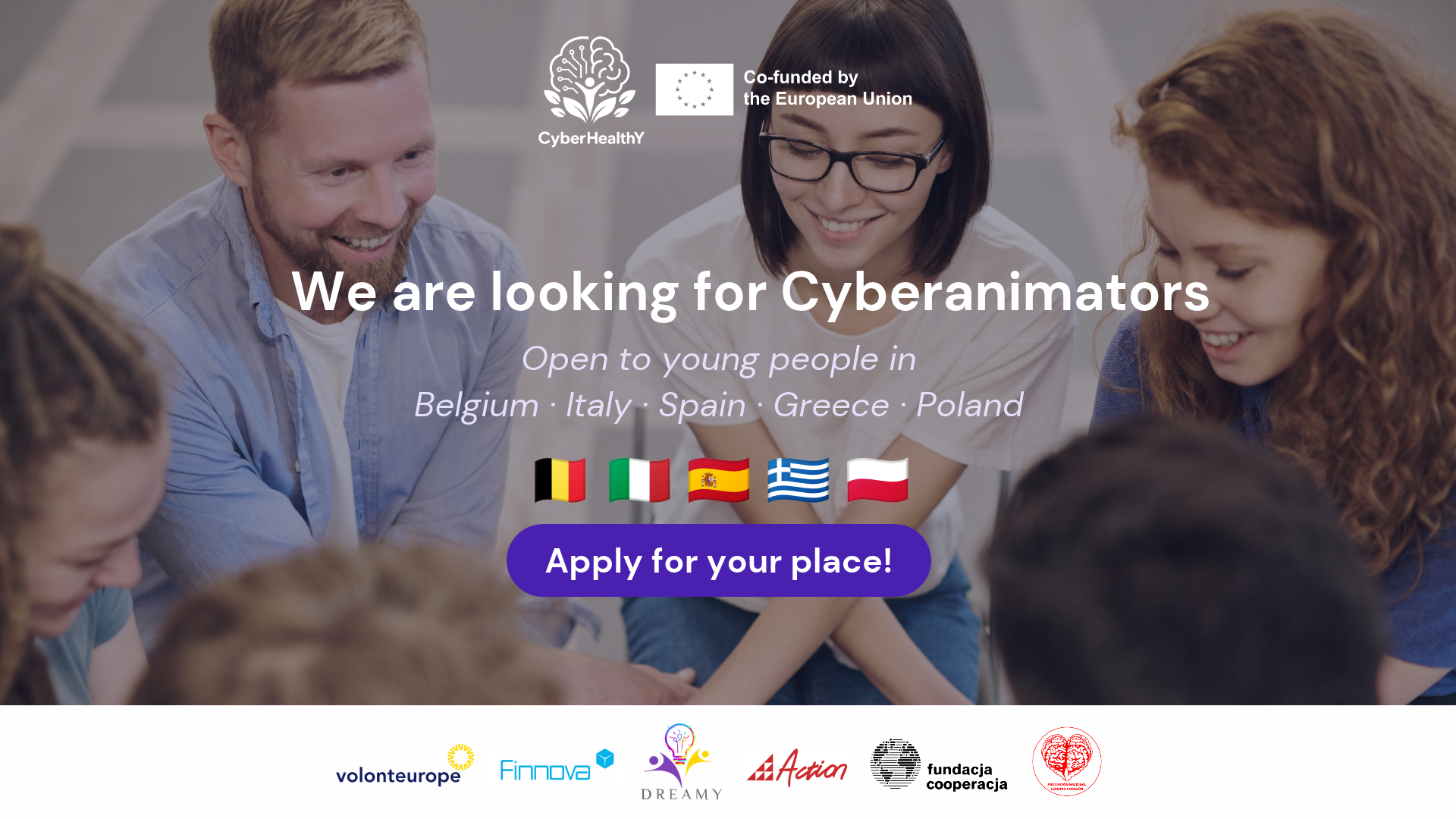
To achieve this objective, CyberHealthY has launched an open call to recruit 30 youth workers who will receive dedicated training to become Cyberanimators. The selection process is already underway across the five partner countries – Belgium, Greece, Italy, Spain and Poland – with six participants to be selected in each country.
The call is still open, and interested candidates are welcome to apply. Partner organisations are currently collecting and reviewing applications, with the aim of building diverse national teams whose members share a strong interest in the project's objectives and a willingness to put their learning into practice.
Who are we looking for and how does the selection process work?
The call is addressed to young people aged 18–35 in Belgium, Greece, Italy, Spain and Poland, particularly youth workers, educators and volunteers actively involved in non-formal education, youth work or community activities with young people. Exceptions to the age limit may be considered by the partner organisations.
Ideal candidates should be interested in youth mental health, digital wellbeing and inclusive online participation. They should be motivated to learn, exchange experiences and collaborate with people from different backgrounds, have basic confidence in using online tools or be willing to develop their digital skills, and be available to participate in the blended training programme and contribute to the development of their national Cybercommunity.
A good command of English is required to participate in the transnational activities.
Previous expertise in mental health or digital wellbeing is welcome, but not a prerequisite. No specific academic degree, clinical qualification, minimum number of years of experience or previous Erasmus+ participation is required.
Each partner organisation will select six participants through an open and transparent process, assessing applications based on candidates' motivation, commitment, availability, experience working with young people and willingness to contribute to their national Cybercommunity. The selection will also prioritise learning potential, collaborative skills and respect for safeguarding, confidentiality, data protection and professional boundaries. The process aims to promote diversity and inclusion, welcoming candidates from different backgrounds and levels of experience, including those at the early stages of their youth work journey.
Selected participants will be expected to complete at least 80% of the blended learning programme, including the essential training on safeguarding and professional boundaries, practical simulations and contributions to their national portfolio and Cybercommunity Blueprint. The learning pathway will also include a final reflection and personal action plan. These are training requirements, not skills candidates must already possess before applying.
Interested candidates can apply through the following link: https://form.jotform.com/263024416014040
A blended learning pathway: from training to local action
The 30 selected youth workers will participate in a blended learning pathway scheduled from December 2026 to March 2027. The programme combines five self-paced training modules, seven live transnational webinars, national team assignments and a five-day international training in Athens, Greece, taking place in March 2027.
Throughout the programme, participants will explore digital wellbeing and mental health in youth work, Cyberanimation methodologies, safe online facilitation and moderation, emotional support, active listening, safeguarding, youth engagement and inclusion.
The learning experience will also involve practical activities aimed at translating knowledge into action. Together with young people and local stakeholders, participants will contribute to co-designing and testing a National Cybercommunity Blueprint, covering participation, moderation, safeguarding and referral arrangements.
They will also prepare a 90-day Launch Plan and contribute to the implementation of their respective national Cybercommunities, helping bring the project's objectives into their local contexts.
About CyberHealthY
Co-ordinated by Volonteurope, CyberHealthY brings together six organisations from Belgium, Italy, Greece, Poland and Spain: Volonteurope, DREAMY, Action Synergy, the Finnova Foundation, Fundacja Cooperacja and the Cerebro Corazón National Association. Running from January 2026 to December 2027, the project has received a total grant of €250,000 from the Erasmus+ programme.